
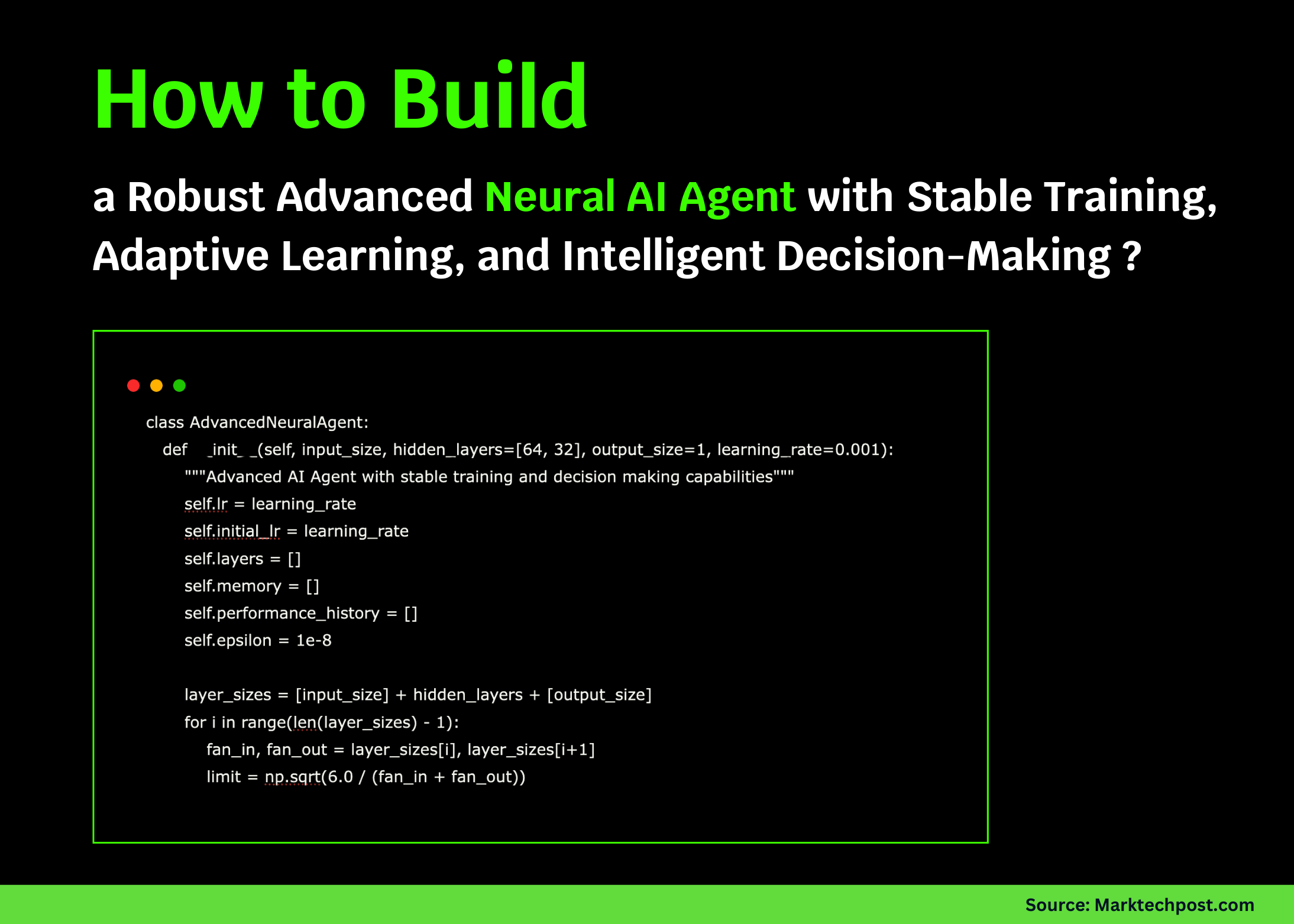
class AdvancedNeuralAgent:
   def __init__(self, input_size, hidden_layers=(64, 32), output_size=1, learning_rate=0.001):
       """Superior AI Agent with steady coaching and choice making capabilities"""
       self.lr = learning_rate
       self.initial_lr = learning_rate
       self.layers = ()
       self.reminiscence = ()
       self.performance_history = ()
       self.epsilon = 1e-8

       layer_sizes = (input_size) + hidden_layers + (output_size)
       for i in vary(len(layer_sizes) - 1):
           fan_in, fan_out = layer_sizes(i), layer_sizes(i+1)
           restrict = np.sqrt(6.0 / (fan_in + fan_out))

           layer = {
               'weights': np.random.uniform(-limit, restrict, (layer_sizes(i), layer_sizes(i+1))),
               'bias': np.zeros((1, layer_sizes(i+1))),
               'momentum_w': np.zeros((layer_sizes(i), layer_sizes(i+1))),
               'momentum_b': np.zeros((1, layer_sizes(i+1)))
           }
           self.layers.append(layer)

   def activation(self, x, func="relu"):
       """Steady activation features with clipping"""
       x = np.clip(x, -50, 50)

       if func == 'relu':
           return np.most(0, x)
       elif func == 'sigmoid':
           return 1 / (1 + np.exp(-x))
       elif func == 'tanh':
           return np.tanh(x)
       elif func == 'leaky_relu':
           return np.the place(x > 0, x, x * 0.01)
       elif func == 'linear':
           return x

   def activation_derivative(self, x, func="relu"):
       """Steady derivatives"""
       x = np.clip(x, -50, 50)

       if func == 'relu':
           return (x > 0).astype(float)
       elif func == 'sigmoid':
           s = self.activation(x, 'sigmoid')
           return s * (1 - s)
       elif func == 'tanh':
           return 1 - np.tanh(x)**2
       elif func == 'leaky_relu':
           return np.the place(x > 0, 1, 0.01)
       elif func == 'linear':
           return np.ones_like(x)

   def ahead(self, X):
       """Ahead move with gradient clipping"""
       self.activations = (X)
       self.z_values = ()

       current_input = X
       for i, layer in enumerate(self.layers):
           z = np.dot(current_input, layer('weights')) + layer('bias')
           z = np.clip(z, -50, 50)
           self.z_values.append(z)

           if i < len(self.layers) - 1:
               a = self.activation(z, 'leaky_relu')
           else:
               a = self.activation(z, 'linear')

           self.activations.append(a)
           current_input = a

       return current_input

   def clip_gradients(self, gradients, max_norm=1.0):
       """Gradient clipping to forestall explosion"""
       grad_norm = np.linalg.norm(gradients)
       if grad_norm > max_norm:
           gradients = gradients * (max_norm / (grad_norm + self.epsilon))
       return gradients

   def backward(self, X, y, output):
       """Steady backpropagation with gradient clipping"""
       m = X.form(0)

       dz = (output - y.reshape(-1, 1)) / m
       dz = np.clip(dz, -10, 10)

       for i in reversed(vary(len(self.layers))):
           layer = self.layers(i)

           dw = np.dot(self.activations(i).T, dz)
           db = np.sum(dz, axis=0, keepdims=True)

           dw = self.clip_gradients(dw, max_norm=1.0)
           db = self.clip_gradients(db, max_norm=1.0)

           momentum = 0.9
           layer('momentum_w') = momentum * layer('momentum_w') + (1 - momentum) * dw
           layer('momentum_b') = momentum * layer('momentum_b') + (1 - momentum) * db

           weight_decay = 0.0001
           layer('weights') -= self.lr * (layer('momentum_w') + weight_decay * layer('weights'))
           layer('bias') -= self.lr * layer('momentum_b')

           if i > 0:
               activation_func="leaky_relu" if i > 1 else 'leaky_relu'
               dz = np.dot(dz, layer('weights').T) * self.activation_derivative(
                   self.z_values(i-1), activation_func)
               dz = np.clip(dz, -10, 10)

   def adapt_learning_rate(self, epoch, performance_history):
       """Adaptive studying fee with performance-based adjustment"""
       if epoch > 10:
           recent_performance = performance_history(-10:)
           if len(recent_performance) >= 5:
               if recent_performance(-1) >= recent_performance(-5):
                   self.lr = max(self.lr * 0.95, self.initial_lr * 0.01)
               elif recent_performance(-1) < recent_performance(-5) * 0.98:
                   self.lr = min(self.lr * 1.02, self.initial_lr * 2)

   def calculate_loss(self, y_true, y_pred):
       """Steady loss calculation"""
       y_true = y_true.reshape(-1, 1)
       y_pred = np.clip(y_pred, -1e6, 1e6)

       mse = np.imply((y_true - y_pred) ** 2)
       mae = np.imply(np.abs(y_true - y_pred))

       if not np.isfinite(mse):
           mse = 1e6
       if not np.isfinite(mae):
           mae = 1e6

       return mse, mae

   def store_experience(self, state, motion, reward, next_state):
       """Expertise replay for RL points"""
       expertise = {
           'state': state,
           'motion': motion,
           'reward': reward,
           'next_state': next_state,
           'timestamp': len(self.reminiscence)
       }
       self.reminiscence.append(expertise)

       if len(self.reminiscence) > 1000:
           self.reminiscence.pop(0)

   def make_decision(self, X, exploration_rate=0.1):
       """Steady choice making"""
       prediction = self.ahead(X)

       if np.random.random() < exploration_rate:
           noise_scale = np.std(prediction) * 0.1 if np.std(prediction) > 0 else 0.1
           noise = np.random.regular(0, noise_scale, prediction.form)
           prediction += noise

       return np.clip(prediction, -1e6, 1e6)

   def reset_if_unstable(self):
       """Reset community if coaching turns into unstable"""
       print("🔄 Resetting community as a result of instability...")
       for i, layer in enumerate(self.layers):
           fan_in, fan_out = layer('weights').form
           restrict = np.sqrt(6.0 / (fan_in + fan_out))
           layer('weights') = np.random.uniform(-limit, restrict, (fan_in, fan_out))
           layer('bias') = np.zeros((1, fan_out))
           layer('momentum_w') = np.zeros((fan_in, fan_out))
           layer('momentum_b') = np.zeros((1, fan_out))
       self.lr = self.initial_lr

   def practice(self, X, y, epochs=500, batch_size=32, validation_split=0.2, verbose=True):
       """Strong coaching with stability checks"""
       y_mean, y_std = np.imply(y), np.std(y)
       y_normalized = (y - y_mean) / (y_std + self.epsilon)

       X_trn, X_val, y_trn, y_val = train_test_split(
           X, y_normalized, test_size=validation_split, random_state=42)

       best_val_loss = float('inf')
       endurance = 30
       patience_counter = 0

       train_losses, val_losses = (), ()
       reset_count = 0

       for epoch in vary(epochs):
           if epoch > 0 and (not np.isfinite(train_losses(-1)) or train_losses(-1) > 1e6):
               if reset_count < 2:
                   self.reset_if_unstable()
                   reset_count += 1
                   proceed
               else:
                   print("🚫 Coaching unstable, stopping...")
                   break

           indices = np.random.permutation(len(X_train))
           X_train_shuffled = X_train(indices)
           y_train_shuffled = y_train(indices)

           epoch_loss = 0
           batches = 0
           for i in vary(0, len(X_trn), batch_size):
               batch_X = X_train_shuffled(i:i+batch_size)
               batch_y = y_train_shuffled(i:i+batch_size)

               if len(batch_X) == 0:
                   proceed

               output = self.ahead(batch_X)
               self.backward(batch_X, batch_y, output)

               loss, _ = self.calculate_loss(batch_y, output)
               epoch_loss += loss
               batches += 1

           avg_train_loss = epoch_loss / max(batches, 1)

           val_output = self.ahead(X_val)
           val_loss, val_mae = self.calculate_loss(y_val, val_output)

           train_losses.append(avg_train_loss)
           val_losses.append(val_loss)
           self.performance_history.append(val_loss)

           if val_loss < best_val_loss:
               best_val_loss = val_loss
               patience_counter = 0
           else:
               patience_counter += 1

           if patience_counter >= endurance:
               if verbose:
                   print(f"✋ Early stopping at epoch {epoch}")
               break

           if epoch > 0:
               self.adapt_learning_rate(epoch, self.performance_history)

           if verbose and (epoch % 50 == 0 or epoch < 10):
               print(f"Epoch {epoch:3d}: Practice Loss = {avg_train_loss:.4f}, "
                     f"Val Loss = {val_loss:.4f}, LR = {self.lr:.6f}")

       self.y_mean, self.y_std = y_mean, y_std
       return train_losses, val_losses

   def predict(self, X):
       """Make predictions with denormalization"""
       normalized_pred = self.ahead(X)
       if hasattr(self, 'y_mean') and hasattr(self, 'y_std'):
           return normalized_pred * self.y_std + self.y_mean
       return normalized_pred

   def evaluate_performance(self, X, y):
       """Complete efficiency analysis"""
       predictions = self.predict(X)
       mse, mae = self.calculate_loss(y, predictions)

       y_mean = np.imply(y)
       ss_tot = np.sum((y - y_mean) ** 2)
       ss_res = np.sum((y.reshape(-1, 1) - predictions) ** 2)
       r2 = 1 - (ss_res / (ss_tot + self.epsilon))

       return {
           'mse': float(mse) if np.isfinite(mse) else float('inf'),
           'mae': float(mae) if np.isfinite(mae) else float('inf'),
           'r2': float(r2) if np.isfinite(r2) else -float('inf'),
           'predictions': predictions.flatten()
       }

   def visualize_training(self, train_losses, val_losses):
       """Visualize coaching progress"""
       plt.determine(figsize=(15, 5))

       plt.subplot(1, 3, 1)
       plt.plot(train_losses, label="Coaching Loss", alpha=0.8)
       plt.plot(val_losses, label="Validation Loss", alpha=0.8)
       plt.title('Coaching Progress')
       plt.xlabel('Epoch')
       plt.ylabel('Loss')
       plt.legend()
       plt.grid(True, alpha=0.3)
       plt.yscale('log')

       plt.subplot(1, 3, 2)
       if len(self.performance_history) > 0:
           plt.plot(self.performance_history)
           plt.title('Efficiency Historical past')
           plt.xlabel('Epoch')
           plt.ylabel('Validation Loss')
           plt.grid(True, alpha=0.3)
           plt.yscale('log')

       plt.subplot(1, 3, 3)
       if hasattr(self, 'lr_history'):
           plt.plot(self.lr_history)
           plt.title('Studying Charge Schedule')
           plt.xlabel('Epoch')
           plt.ylabel('Studying Charge')
           plt.grid(True, alpha=0.3)

       plt.tight_layout()
       plt.present()